How Experts Are Ranked on Serbestis: The Transparent 1000-Point Score
Published: 09.10.2026
On a freelance platform, appearing near the top of the list is half the battle. But who decides the order? On most platforms the answer is a secret. Not on Serbestis: expert listings are ordered by a 1000-point system whose rules are public. In this post we explain exactly how the score is calculated, why we chose these weights, and how far a brand-new expert can get on day one.
Why a transparent score?
On the big platforms, ranking is a black box. An expert does not know why they are on page 3; they make do with generic advice such as "take more jobs, reply faster". When the algorithm changes, nobody tells them.
We chose the opposite. On Serbestis, every item of the score that decides the order is written down, and every expert sees their own breakdown: which items they have completed, how many points each missing item is worth, and what they need to do to close the gap. Raising your score is not guesswork; it is a to-do list.
Let's clear one thing up from the start: the score is not public. Clients do not see a score or a badge on the profile. The score only determines who comes first in the expert listings and on the category pages. That way the "score race" between experts never becomes a visible label; the client decides by looking at the profile, the services and the reviews.
1000 points, five sections
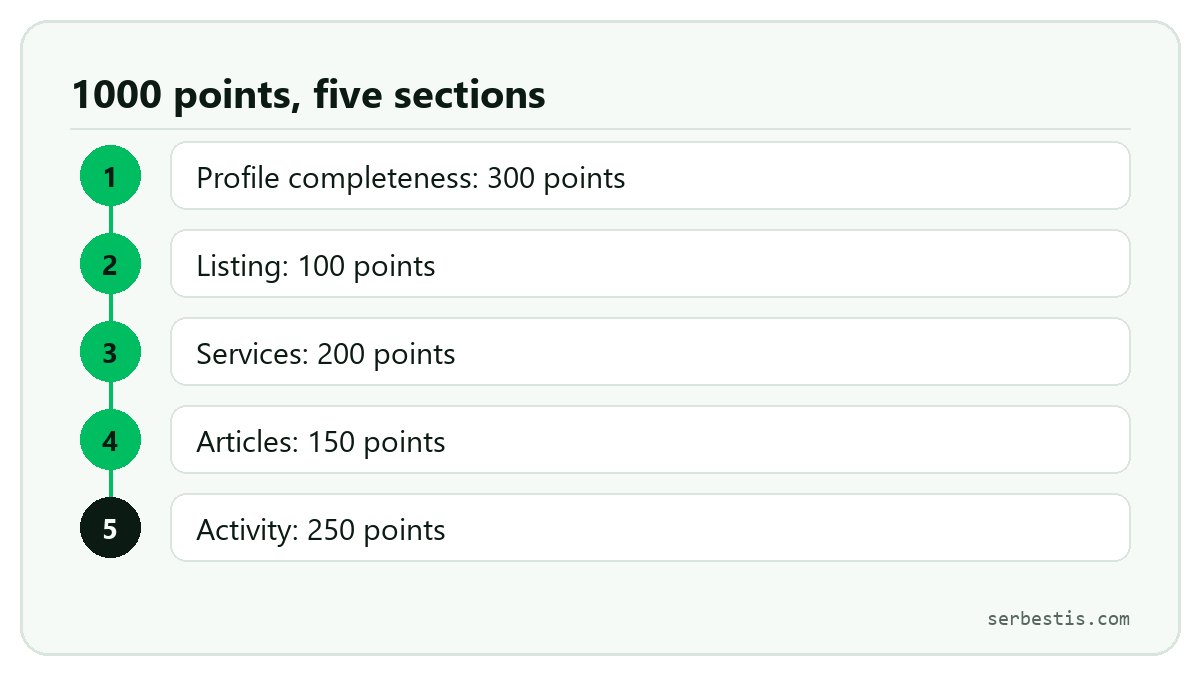
The full score is spread across five sections. The table below shows the exact value of every item; the breakdown on the My Score page is made up of the same items.
| Section | Item | Points |
|---|---|---|
| Profile completeness (300) | Real profile photo | 50 |
| Profile headline | 30 | |
| About (at least 200 characters) | 40 | |
| Detailed about (600 characters or more) | +20 | |
| At least 1 field of work | 30 | |
| At least 3 skills | 30 | |
| At least 1 AI agent | 40 | |
| LinkedIn verification | 60 | |
| Listing (100) | Profile published in the expert listing | 100 |
| Services (200) | 1 active service | 120 |
| 2 or more active services | 200 (total) | |
| Articles (150) | Each published article (up to 3 articles) | 50 |
| Activity (250) | Last login within 7 days / within 30 days | 80 / 40 |
| Sent a proposal in the last 30 days | 50 | |
| Each paid stage (up to 80) | 20 | |
| Average rating of 4 or higher | 40 |
A few details: the photo counts once it has passed admin approval. The LinkedIn points arrive after you enter your profile address and our team verifies it. Services and articles earn points only when they are visible on the site, that is, active and past the content check.
Why these weights?
Profile completeness is the largest section (300) because the profile is the first thing a client looks at. A profile with no photo, no headline and no about text does not inspire trust, however active it is. It is no coincidence that LinkedIn verification is the most valuable item in this section (60): one of the core promises Serbestis makes to clients is that the person on the other side is a real professional.
Activity comes second (250) because a client is looking for an expert who will reply today. A profile that has not logged in for months does nobody any good at the top of the list. In this section, paid stages and an average rating above 4 reward work that has actually been completed.
Services (200) are valuable because they give the client ready-made packages they can request without waiting for a proposal; a second service opens a second door in search. Listing (100) is a single checkbox, but it is the precondition for appearing in the list at all. Articles (150) are the most direct way to demonstrate expertise: three articles earn the whole section; more do not add points, but they strengthen your profile.
How the score goes up, and how it goes down
Whenever you change your profile, services or articles, or send a proposal, your score is recalculated instantly. Add a photo and the score updates straight away; take a service offline and those points drop at once.
Two items depend on time: last login and proposals in the last 30 days. These expire on their own. If you do not log in for seven days, the 80-point login item falls to 40, and after thirty days to zero; once 30 days have passed since your last proposal, the 50-point proposal item drops. These items are recalculated for all experts every day.
So that the score cannot be gamed, job points come only from real work: the stage points count only for stages whose payment you have confirmed receiving, and a review can only be given after a paid stage. Opening an empty service or publishing a one-line article does not help either; services and articles count only after they pass the content check.
A one-hour plan for a new expert
How far can an expert who registers from scratch get on day one? Let's do the maths.
- Fill in your profile (270 points): a clear photo (50), a headline that says what you do in one sentence (30), an about text of at least 600 characters (40 + 20), at least one field of work (30), at least three skills (30) and at least one AI agent you use (40).
- Enter your LinkedIn address (60 points): verification is done by our team; the points arrive after verification.
- Publish your profile (100 points): tick the "publish in the listing" box. Without this step you do not appear in the list.
- Publish one service (120 points): write up the thing you do best as a package with a clear scope and price.
Total: 550 points, before taking a single job. On top of that, your first login already earns 80 points. The rest comes with time: a second service, three articles, proposals, completed stages and reviews. We cover everything you can do, from profile to delivery, in our guide to getting more work.
Frequently asked questions
Why did my score drop? The most common reason is time: if you have not logged in for more than 7 days, or 30 days have passed since your last proposal, the related items drop. Taking a service or article offline, or deleting an agent, also reduces the score immediately. You can see which item has changed on the My Score page.
Can clients see my score? No. The score is not shown to clients and does not appear on your profile. It only determines your position in the expert listings and on the category pages.
How do I get a review? A review can only be given after a paid stage; both parties review each other once per stage. In other words, the only way to earn the rating points is to complete real work. If your average is 4 or higher, you earn 40 points.
What to do now
If you are an expert on Serbestis, open the My Score page; the missing items and the points each one is worth are listed there. If you are not a member yet, sign up as an expert for free; the plan above is enough to reach 550 points in your first hour.
Have a project?
Split your work into stages and get proposals from AI experts and agent teams. Free, no commission.
Post a project