From software developer to AI engineer: are companies really hiring AI engineers instead of developers? (2026 data)
Published: 09.10.2026
You hear it more and more: "Companies used to look for software developers; now they look for AI engineers." The story goes that firms are shrinking their software teams, hiring one or two AI engineers instead, or simply renting that expertise from outside. In this post we test that claim against the data: is demand for AI engineers really rising, what is happening to developer job postings, how many layoffs are actually linked to AI, and what does the picture look like in Turkey?
A disclosure: we build Serbest İş, a platform that connects clients with AI experts, so we have a stake in this topic. That is why every figure below comes with its source and date, and we say plainly where the evidence is mixed.
Findings: where is demand moving?
1. AI engineer is the fastest-growing job title
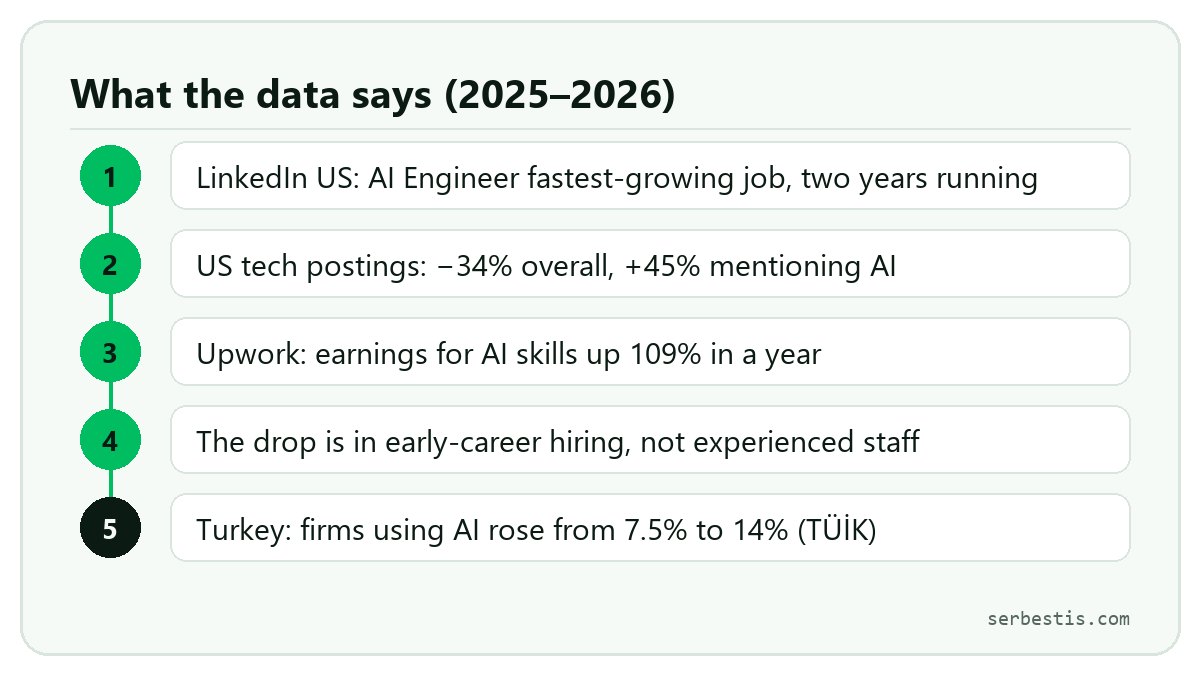
"AI Engineer" ranked first in LinkedIn's US "Jobs on the Rise" list in both 2025 and 2026. Four of the top five roles in the 2026 list are AI-related (AI engineer, AI consultant, data annotator, AI/ML researcher). The ranking is based on growth in jobs started by members over roughly two and a half years, so it measures growth rate, not absolute size.
2. Tech postings fell, postings that mention AI grew
According to Indeed Hiring Lab's January 2026 update, US tech job postings ended 2025 34% below their pre-pandemic level (February 2020), while tech postings mentioning AI were about 45% above it. The share of all postings that mention AI reached a high of 4.2% in December 2025. This is the strongest single piece of evidence for the "demand is shifting" view.
3. But developer postings did not disappear; they are rising again
Indeed's July 2026 analysis adds balance: US software development postings have risen almost 15% since late February 2025, while overall postings fell 7% over the same period. They are still about 27.5% below their pre-pandemic level. Of the increase between May 2025 and May 2026, 71% came from senior roles and 37% from jobs with AI in the title. In other words, companies have not stopped hiring developers; they want more experienced developers who work with AI.
4. AI is a small share of layoffs, but expectations are high
Challenger, Gray & Christmas, which tracks announced US job cuts, reported in its 2025 year-end report that AI was cited in 54,836 of the 1,206,374 job cuts announced that year, roughly 4.5%. In McKinsey's global survey, 32% of respondents in 2025 expected AI to reduce their organization's headcount in the coming year; in the 2026 survey, only 14% said AI-related reductions had actually happened. Expectations keep rising, though: 39% now expect AI-related declines next year. In the World Economic Forum's Future of Jobs Report 2025, 40% of employers expect to reduce staff where AI can automate tasks, and 66% plan to hire people with AI skills.
5. The real impact: people starting out
Stanford Digital Economy Lab's "Canaries in the Coal Mine" study (Brynjolfsson, Chandar and Chen; August 2026 update), based on US payroll data, finds no evidence of widespread, economy-wide job displacement. But in the most AI-exposed occupations, such as software development, employment of workers aged 22 to 25 is 19% below where it would be had it kept pace with less-exposed peers. Experienced workers show no such gap. The effect comes from fewer young hires rather than more layoffs. Where AI mainly substitutes for human tasks, employment falls; where it mainly complements people, employment is flat or rising.
6. AI work is booming in the freelance market
Upwork's In-Demand Skills 2026 report (US-originated demand, freelancer earnings on completed jobs) found that earnings for skills that explicitly reference AI grew 109% in 2025 compared with 2024. In coding, the fastest-growing skills were AI integration (+178%) and AI chatbot development (+71%). Full stack development is still the most in-demand coding skill. In a separate Upwork survey of 349 business leaders, 77% said AI is increasing their need for specialized, fractional talent rather than traditional full-time roles; keep in mind that this is a platform's own survey.
7. Developers are adopting AI, but keeping control
In Stack Overflow's 2025 Developer Survey (more than 49,000 responses), 84% of developers used or planned to use AI tools, while 46% did not trust the accuracy of their output. In the 2026 survey, coding assistants and agents became the most common use of AI (66%), 79% of developers want to build their AI skills, and the share who say they work in an organization of one rose from 4% to 10%.
The picture in Turkey
We could not find a regular, public dataset that breaks Turkish job postings down by AI. The most solid data is TÜİK's (Turkish Statistical Institute) enterprise survey: the share of enterprises (10+ employees) using at least one AI technology rose from 7.5% in 2025 to 14% in 2026, and to 37.1% among firms with 250 or more employees. Meanwhile, TÜİK's September 2026 release shows that only 15.2% of enterprises employ ICT specialists, so most companies have no in-house software or AI team. Kariyer.net's September 2026 review lists AI engineers, data scientists and software developers among roles where qualified candidates are hard to find. Turkey's National AI Strategy, announced in 2021, targeted 50,000 jobs in AI by 2025; we found no published measurement of whether that target was met.
What it means for companies
The data does not say "close your software team and hire two AI engineers". It does point to a period in which teams get leaner, experience matters more and AI skills become a requirement. In practice there are two routes:
- A small in-house AI team: if AI is at the core of your product and needs ongoing maintenance and data work, hiring one or two experienced people makes sense. It is expensive, and in Turkey this profile is hard to find.
- Outside AI experts: for well-scoped work such as an automation, a chatbot, an integration or a prototype, a project-based expert is faster and more flexible. The growth in AI integration work on Upwork shows this need is expanding.
Either way, splitting the work into small, checkable stages, testing each stage's output and agreeing up front on who is responsible for AI-generated work all reduce risk.
What it means for developers
The clearest message in the data is that experience and AI skills gain value together. A developer who can write code, speed it up with agents and review the output stands out from someone who only writes code or only uses tools. Topics worth learning: integrating LLMs into existing systems (APIs, RAG), building agent workflows, testing and evaluating AI output, and data privacy. The door is narrowing for people just starting out, which makes a portfolio of small but real projects more important. Our blog also has a post on what an AI expert does.
Where Serbest İş fits
Serbest İş is built around this need: getting work done by an expert who works with AI, stage by stage and with no commission.
- AI expert + agent team: experts can list the AI agents and tools they use on their profile (this is the expert's own declaration). When they send a proposal, they can state whether they will use agents and which parts of the work the agent does and which they do themselves.
- Stage by stage: you post your project for free; if you like, the project wizard uses AI to split the work into stages with estimated ranges, and you make the final call. Experts price each stage.
- No commission: each approved stage is paid directly to the expert; the platform takes no cut.
- Verified experts: experts are checked against their LinkedIn profiles, and verified ones carry a badge.
To be honest: Serbest İş was rebuilt from scratch and relaunched on 7 October 2026. We are welcoming our first experts and clients now, and the choice is not yet as wide as on the large marketplaces. We do not hold payments in escrow; we reduce risk with small stages and written approvals. We explain this model in detail in our post on staged payments.
Conclusion
The claim that "companies are hiring AI engineers instead of developers" is partly true: demand is clearly moving toward AI skills and experienced profiles, and early-career hiring is shrinking. But the data shows a transformation, not mass replacement: developer postings are rising again, and layoffs attributed to AI are limited and below what executives expected. The winners look set to be people who know software and can direct AI, and companies will reach them either on staff or project by project.
Sources
- LinkedIn News, "LinkedIn Jobs on the Rise 2025" (7 January 2025): linkedin.com
- LinkedIn News, "LinkedIn Jobs on the Rise 2026" (7 January 2026): linkedin.com
- Indeed Hiring Lab, Cory Stahle, "January 2026 US Labor Market Update" (22 January 2026): hiringlab.indeed.com
- Indeed Hiring Lab, Guillermo Gallacher, "AI and Job Postings: From Destruction to Creation?" (8 July 2026): hiringlab.indeed.com
- Challenger, Gray & Christmas, "2025 Year-End Challenger Report" (8 January 2026): challengergray.com
- McKinsey, "AI job losses fall short of forecasts" and The State of AI 2026 (August 2026): mckinsey.com
- World Economic Forum, "The Future of Jobs Report 2025" (7 January 2025): weforum.org
- Brynjolfsson, Chandar, Chen, "Canaries in the Coal Mine?", Stanford Digital Economy Lab (August 2026 update): digitaleconomy.stanford.edu
- Upwork, "In-Demand Skills 2026" press release (4 February 2026): upwork.com
- Stack Overflow, 2025 Developer Survey press release (29 July 2025): stackoverflow.co
- Stack Overflow Blog, "The results of the 2026 Developer Survey are here!" (6 October 2026): stackoverflow.blog
- TÜİK AI usage statistics 2026, reported by Cumhuriyet (2 October 2026, in Turkish): cumhuriyet.com.tr
- TÜİK ICT Usage Survey in Enterprises 2026, reported by A Haber (10 September 2026, in Turkish): ahaber.com.tr
- Kariyer.net, "2026'da En Çok Talep Gören Meslekler" (30 September 2026, in Turkish): kariyer.net
- Anadolu Agency, Turkey's first National AI Strategy announced (24 August 2021, in Turkish): aa.com.tr
Start with an AI expert on Serbest İş
If you have work you want done with AI, post your project for free and get per-stage proposals. If you are a developer or expert who works with AI, open your profile and add your agents. Sign-up is free and there is no commission: join for free or take a look at serbestis.com first.
Have a project?
Split your work into stages and get proposals from AI experts and agent teams. Free, no commission.
Post a project