With So Many Freelance Sites Out There, Why Serbestis? An Honest Comparison
Published: 09.10.2026
"Turkey already has Bionluk and Armut; abroad there are Upwork, Fiverr and Freelancer.com. Why one more platform?" That is the question we hear most often when we describe Serbestis. It is a fair question. In this post we give our answer as honestly as we can: what we do differently, where we are still weak, and who Serbestis is right for, and who it is not.
What do the existing platforms do well?
Let's give credit where it is due. The big freelance marketplaces have made millions of jobs possible over the years. Their greatest strength is payment protection: the money is held on the platform and released to the freelancer once the work is approved. They offer a wide range of categories, mature review systems and large user bases. For one-off, standard jobs such as logos, translations or video editing, these models work well.
Job boards such as Kariyer.net and eleman.net focus mainly on job postings and CV matching. LinkedIn is indispensable for professional networking and reputation, but it was not designed for running projects.
It comes at a price: commission
Payment protection and running a platform cost money. That cost is usually covered by commission. The rates stated in the platforms' own terms:
- Fiverr: The seller receives 80% of the order amount; the buyer also pays a 5.5% service fee (Fiverr Payment Terms).
- Upwork: A service fee of 0–15% from the freelancer depending on the contract, plus a marketplace fee charged to the client (Upwork pricing page).
- Freelancer.com: On fixed-price jobs, 10% or 5 US dollars from the freelancer, whichever is greater (Freelancer.com Fees and Charges page).
- Bionluk: A 20% service fee is deducted from orders.
- Armut: The service provider pays a fee to send quotes and, on agreed jobs, a commission at the rate Armut sets (Armut User Agreement).
These rates are not bad faith; they are a business model. But the outcome is the same: a 20% deduction either comes out of the expert's earnings or is added to the price and passed on to the client. You can also read our comparison of freelance platforms, where we go through each platform's payment flow and fees one by one.
Why are AI projects different?
An AI project is rarely a one-off order. A job like "let's build an assistant that works with our internal documents" consists of stages: needs analysis, data preparation, a prototype, integration and refinement. The scope becomes clearer as the work progresses. On top of that, the client's data sits at the centre of the job: which data goes to which model and which cloud service has to be discussed up front, for both security and data protection (KVKK) reasons.
General marketplaces are open to this kind of work too, but there "AI" is one category among dozens. It is left to the client to work out which tools and which agents the expert actually works with.
What makes Serbestis different?
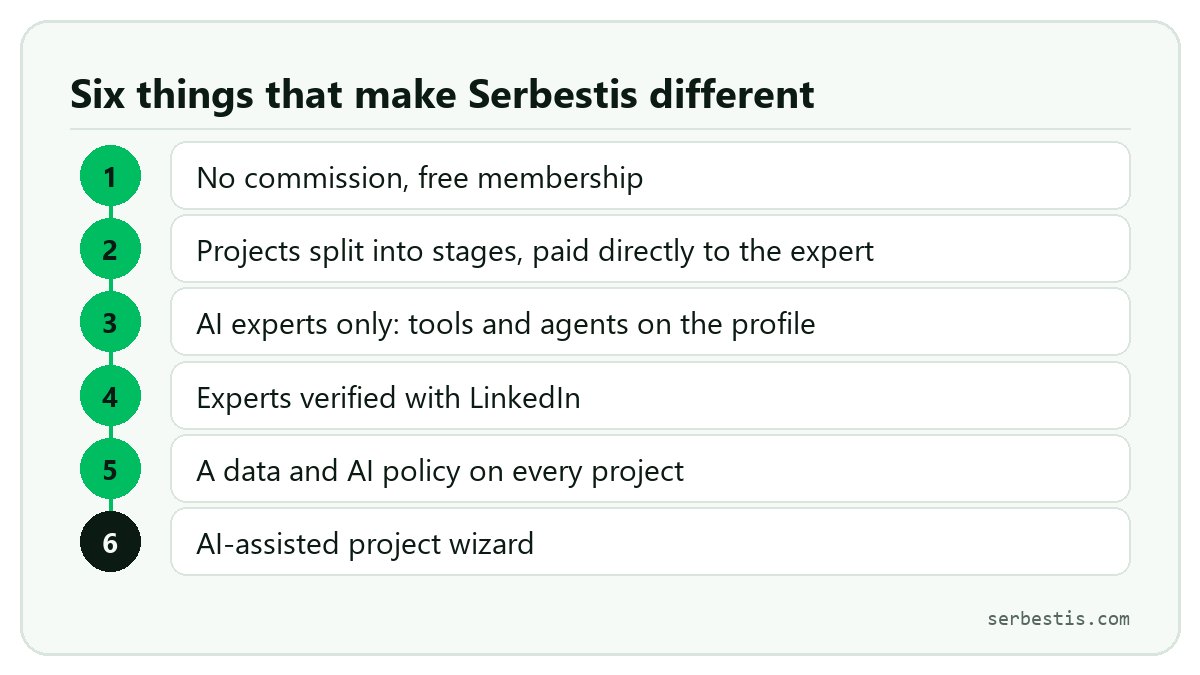
No commission, free membership. Neither the client nor the expert pays Serbestis anything. The expert quotes their real price without calculating deductions.
The project is split into stages, and payment is made directly, stage by stage. The client pays the expert directly after each completed stage, not through the platform. Instead of putting a large sum at risk in one go, you split the risk into small pieces.
AI experts only. Serbestis is not a marketplace for everything. Profiles list the AI tools the expert uses and the agents they have built; experts can publish ready-made packaged services and share their experience in articles.
Experts verified with LinkedIn. The client can see that the person on the other side is a real professional, along with their career history.
A data and AI policy on every project. When creating a project, the client states how their data may be used and which tools it may be fed into. The expert sees this before sending a proposal.
An AI-assisted project wizard. A client who cannot describe what they want in technical terms turns their project into a clear, stage-by-stage description by answering the project wizard's questions.
Side by side
| General freelance marketplaces | Job boards | Serbestis | |
|---|---|---|---|
| Platform deduction | Yes (varies by platform) | Listing-fee model is common | None |
| Payment | Through the platform, protected | Between the parties | Stage by stage, directly to the expert |
| Focus | Many categories | Full-time / part-time employment | AI experts and agents |
| Expert verification | The platform's own methods | Self-declared CV | LinkedIn verification |
| Data / AI policy | General terms of use | None | Per project, set by the client |
| Scoping | Listing text | Listing text | AI-assisted project wizard |
Let's be honest: our weaknesses
We do not offer escrow. Because payment is made directly, the money does not wait with an intermediary. We try to balance this with staged payment, LinkedIn verification, reviews and clear scoping; even so, we recommend keeping the first stage small and not skipping the basics such as a contract and an invoice.
We are new. We do not have the volume of experts and projects the big platforms have. Don't expect dozens of proposals in every category; on the other hand, the experts who do send proposals are selected and verified.
Experts without a LinkedIn account cannot complete the verification step for now.
Who is Serbestis for?
For clients who want to bring AI into their business, see the stages of their project, know where their data goes and work directly with the expert. And for AI experts who want to be paid for their work without deductions; experts can find what they can do, from profile to delivery, in our guide to getting more work.
If you have a standard, one-off job such as a logo or a translation, the big marketplaces are probably a better fit. But if you have an AI project on your hands, you can get started for free with the project wizard at serbestis.com.
Have a project?
Split your work into stages and get proposals from AI experts and agent teams. Free, no commission.
Post a project