
Business Profitability: Why Does Profit Fall While Revenue Rises?
Levent Alaca · Published: 09.11.2026 · Management & strategy consulting
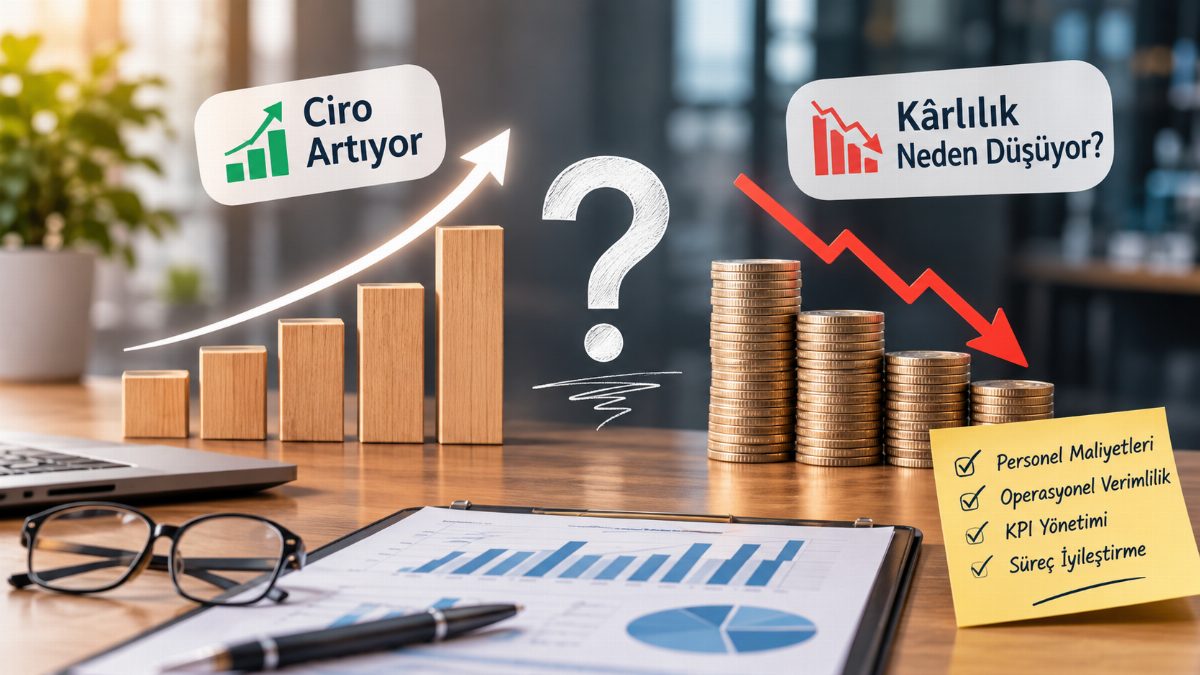
Business profitability is not achieved by increasing sales alone. A company's revenue may rise while its profitability falls. The main causes include uncontrolled personnel costs, operational inefficiencies, performance differences between branches and poorly managed KPIs. So how can you identify these problems that limit your profitability despite your business's growth?
A company's rising revenue does not always mean it is more successful.
If profitability stalls or even declines while sales rise, the business's growth may not be as healthy as it appears.
The root cause is often not a lack of sales, but the operational inefficiencies that accumulate behind growth.
In my more than 15 years of experience in retail, service, manufacturing and operations management, I have seen an important truth: Businesses sometimes overlook how efficiently they use their existing resources while striving to make more sales.
So what are the core problems that drag profitability down while revenue rises?
1. Personnel costs that are out of line with sales volume
An increase in headcount does not always mean increased efficiency.
What matters is placing the right number of employees at the right time with the right workload.
For example, if personnel planning stays at the same level while sales volume drops in certain periods, productivity per employee falls and personnel costs take a larger share of revenue.
Indicators to track:
- Personnel cost / Revenue
- Revenue per employee
- Hourly labour productivity
- Overtime cost
2. Failure to analyse performance differences between branches
For businesses with multiple branches, setting the same revenue target for all of them is not always the right management approach.
Location, customer traffic, opening hours, store size and operational conditions produce different results.
What matters is not only which branch sells more, but which branch uses its resources more efficiently and makes a higher contribution.
Comparing performance across branches reveals opportunities for improvement.
3. Not measuring the real profitability impact of discounts and campaigns
Not every campaign that increases revenue creates the same value for the business.
Discounts can raise sales volume while lowering the gross profit margin. If the campaign's inventory, personnel and operational costs are not taken into account, sales success may be misinterpreted.
Therefore campaigns should be evaluated not only by revenue growth but also by gross profit contribution and return on investment.
4. Invisible losses in operational processes
Unnecessary work steps, repeated transactions, faulty planning, waiting times and inefficient use of resources may each look like small losses.
But over time these losses turn into serious costs.
Analysing processes, identifying bottlenecks in the workflow and eliminating unnecessary steps are critical for sustainable efficiency.
5. Tracking KPIs without interpreting them correctly
Many businesses prepare regular reports. But producing a report and drawing the right management decision from the data are not the same thing.
For example, seeing that the personnel cost ratio has risen is not enough on its own.
The real questions to ask are:
- What is the main reason for the cost increase?
- Did sales volume fall, or did headcount rise?
- Is labour capacity being used correctly?
- Is the problem concentrated in specific branches?
- Which action can deliver how much financial contribution?
The real value of KPI management comes not from monitoring indicators, but from understanding the reasons behind them and taking the right action.
So where should businesses start?
My recommendation is to first evaluate current performance as a whole.
- Examine sales, cost and budget data together.
- Identify performance differences by branch or business unit.
- Assess personnel efficiency with measurable indicators.
- Investigate the root causes of the problems.
- Prioritise the improvement areas with the highest financial impact.
- Set a measurable target and tracking indicator for each action.
Conclusion: Using resources more efficiently, not working more
While managing an operation of 25 stores and more than 2,000 employees at LC Waikiki, I focused on cost optimisation and process improvement. As part of these efforts, I delivered over $2 million in annual savings and a 12.5% improvement in personnel costs.
This experience taught me an important management principle:
Sustainable growth is possible not only by making more sales, but by producing higher value from existing resources.
If you cannot reach your profitability and efficiency targets despite revenue growth, the solution may be to analyse your current operation correctly before taking on new costs.
In your view, which problem affects profitability most in businesses: personnel costs, operational inefficiencies, poor KPI management or uncontrolled growth?
Business profitability Cost optimization Operational efficiency Personnel costs Employee productivity
This article reflects the expert's own views and experience.