
Business Performance Analysis and Personnel Cost Management
Levent Alaca · Published: 09.11.2026 · Management & strategy consulting
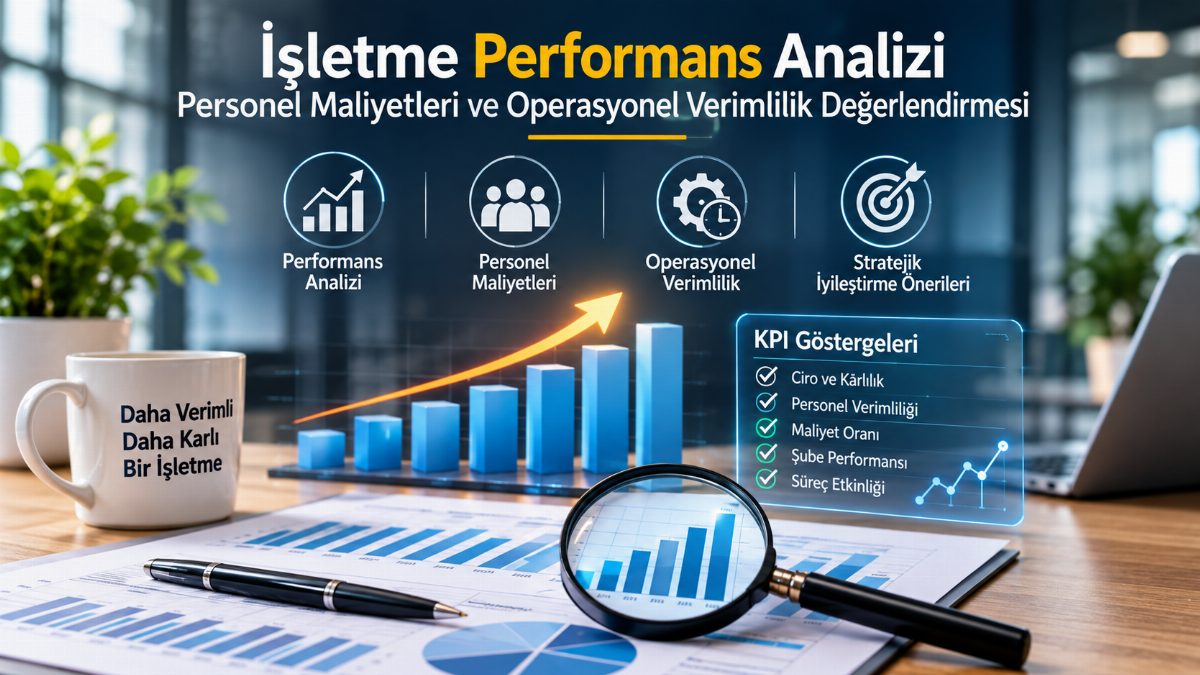
Where Does Efficiency Loss Begin in Your Business? Performance and Personnel Cost Analysis
The problems that reduce a business's profitability are not always clearly visible. Sometimes sales hit targets while costs slip out of control. Sometimes headcount grows but labour efficiency does not. In some businesses, performance gaps between branches drag down the overall results.
What these problems have in common is that business performance is evaluated only through outcome figures. Yet sustainable growth requires sales, cost, budget, personnel efficiency and operational processes to be analysed together.
So exactly where does the efficiency loss in your business begin?
1. Why can business profitability fall while revenue rises?
Revenue growth does not always mean higher profitability. If personnel expenses, operational costs, discounts and other expenses grow faster than sales volume, the business's profit margin can narrow.
That is why focusing only on the total sales figure is not enough.
When evaluating business performance, the following indicators should be examined together:
- Revenue and sales growth rate
- Gross profit and profit margin
- Variance between budgeted and actual expenses
- Ratio of personnel costs to revenue
- Sales per employee
- Share of operational expenses in total cost
What matters is understanding not only how much was sold, but at what cost and with how much efficiency that sale was achieved.
2. Are personnel costs being managed correctly?
Personnel costs are a significant expense item, especially in multi-branch and labour-intensive businesses. However, reducing personnel costs does not by itself mean increased efficiency.
The real issue is planning the existing human resource in line with the workload and operational needs.
For example;
- Having more personnel than necessary during low-workload hours,
- Being unable to build sufficient staff capacity during peak hours,
- Personnel costs differing between branches despite similar workloads,
- Overtime and working hours not being managed effectively,
- Not tracking sales and productivity levels per employee
can cause hidden efficiency losses.
At this point, personnel cost analysis stops being merely a study of expenses. It becomes a management tool that evaluates labour capacity, employee efficiency and resource utilisation together.
3. Why do performance differences between branches matter?
In companies with multiple branches or business units, total performance figures can hide important problems.
For example, two branches operating in the same period may have similar sales. Yet their personnel costs, working hours, customer density and operational expenses may be quite different.
That is why ranking branches by revenue alone is not a correct evaluation method.
For a healthier comparison, the following indicators can be used:
- Revenue and profitability by branch
- Ratio of personnel cost to revenue
- Sales per employee
- Hourly labour productivity
- Budget realisation rate
- Operational expenses
- Customer and service performance
These analyses can reveal which branches use their resources more efficiently and where improvement opportunities exist.
4. Is tracking KPIs enough?
Many businesses prepare KPI reports regularly. Sales, cost, headcount, budget and efficiency indicators are tracked.
But there is a critical gap: the numbers are monitored, yet the causes of the deviations are not investigated enough.
When a KPI falls below target, instead of just recording the outcome, the following questions should be asked:
- Why was the target not met?
- In which branch or business unit is the deviation concentrated?
- Is the problem temporary or structural?
- Which operational process is influencing this result?
- What could the financial contribution be if an improvement is made?
The real value of KPI management comes not from producing reports, but from turning data into a management tool that enables the right decisions.
5. The invisible cost of operational inefficiencies
Some losses in businesses do not appear as a separate expense item in the financial statements.
Unnecessary work steps, repeated transactions, faulty planning, waiting times, misuse of resources and coordination gaps can create significant costs over time.
To identify these losses, current business processes must be examined and the root causes of the problems investigated.
Methods such as Pareto analysis, the 5 Whys approach, process analysis and A3 problem solving can help assess not only the symptoms of the problems but the underlying causes.
The goal here is not to prepare more reports, but to identify the improvement areas with the highest impact.
6. How should business performance analysis be carried out?
An effective business performance analysis consists of complementary stages:
1. Assessment of the current situation: Sales, cost, budget, personnel and operational data are examined.
2. Identification of KPI and performance deviations: Targets are compared with actual results.
3. Investigation of root causes: The process, capacity and resource-utilisation issues that cause performance losses are assessed.
4. Identification of improvement opportunities: Areas for cost optimisation, labour efficiency and process improvement are identified.
5. Creation of a prioritised action plan: Improvement recommendations are developed taking into account expected impact, feasibility and priority.
6. Monitoring results with KPIs: Tracking indicators are defined to measure the impact of the recommended improvements.
This approach helps the business not only understand its current performance but also see which areas it must focus on to operate more efficiently in the future.
Conclusion: The problem may not be in the numbers, but in how they are interpreted
A business's growth should not mean consuming more of its resources. Sustainable success comes from being able to manage sales, costs, human resources and operational processes in a balanced way.
For that, businesses need to look not only at how much they sell, but at how much value they produce with existing resources.
Ask yourself these four questions:
- Are my personnel costs in line with my workload?
- Do my branches and business units operate at similar efficiency with the same resources?
- Do the KPIs I track really enable me to make the right decisions?
- Are there efficiency losses in my business that I have not yet measured or noticed?
The answers to these questions can form the first step you take to improve your business's performance.
Business performance analysis Personnel cost analysis Labour productivity Operational efficiency Cost optimization KPI management Process improvement Branch performance analysis Business management Performance analysis
This article reflects the expert's own views and experience.