
How to Find Freelance Work: A Step-by-Step Guide from First Client to Steady Jobs
Published: 30.10.2026
"How do I find freelance work?" has no single magic answer, but there is an order that works: define what you sell, prove it, show up in the right places and write every proposal with care. This guide is for anyone asking how to start freelancing, and for freelancers who want to fill a gap in their calendar.
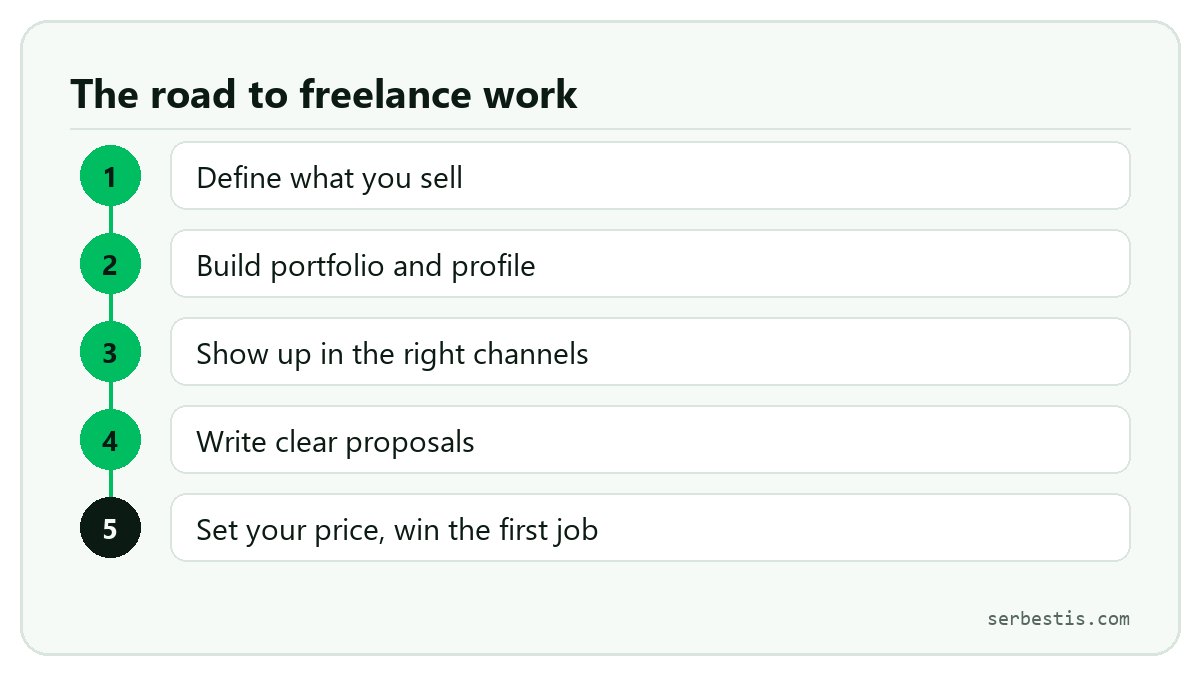
1. Define what you sell
A profile that says "I do everything" is forgotten. Clients look for someone to solve a problem: a logo, an online store, a translation, bookkeeping help, written content. Describe yourself as who you help, with which problem, and how. Picking one field and one service at the start is easier than expanding later.
2. Portfolio and profile: trust starts here
Your first client does not know you. What they need to see is proof. Even if you have no client work yet, you can show your own projects, volunteer work, or study and previous-job work (as far as you are allowed to). For each example, briefly state the problem, what you did and the result.
- A clear photo and a short, plain introduction
- Three to five chosen work samples (more is not required)
- How you work: delivery time, contact hours, revision rules
- References or reviews, if you have them
3. Where to find freelance work
Do not depend on a single channel. The main routes:
- Job platforms: clients post a job and experts send proposals. On Serbestis you can browse open jobs on the Projects page.
- Expert directories: places where clients find your profile. On Serbestis, experts are listed on the Freelancers page.
- Your own network: former colleagues, friends, social media. A good share of first jobs usually comes from here.
- Social networks and communities: LinkedIn, industry groups, forums. Sharing useful knowledge tends to work better than constant advertising.
For differences in how platforms work, pay and charge commission, see our comparison of freelance sites in Türkiye.
4. Writing proposals: this is where most jobs are won
A good proposal shows you actually read the job post. Summarise the goal in your own words, say how you will proceed and when you will deliver, and ask one or two clarifying questions. Do not send the same text to every job. For a longer walkthrough, see our proposal writing guide.
5. Pricing and the first job
Cutting your price hard at the start is tempting, but it can lead to draining clients who are hard to raise prices with later. A better way: define the job together with its scope, quote a reasonable price and work in stages on the first job. A small, well-delivered first job is the strongest reference for the next one.
Frequently asked questions
How do I start freelancing without experience?
Start with your own sample projects, offer small jobs to people around you and collect your first reference. Instead of hiding your inexperience, explain clearly what you do well.
Do I need to set up a company to freelance?
It depends on the type of work and your income, and it is a tax and legal question. We recommend asking a financial advisor before deciding; this article is not tax advice.
Is it easy to find work on Serbestis?
Honestly: Serbestis is a new platform and the number of job posts is still small. In return we charge no commission and payment goes directly between the parties, stage by stage. Experts who join now may find it easier to be visible than on more crowded platforms, but we recommend not relying on a single channel.
When you are ready, create a free profile and then browse the open projects.
Have a project?
Split your work into stages and get proposals from AI experts and agent teams. Free, no commission.
Post a project