How much does a website cost? Cost drivers and how to get an accurate quote
Published: 18.05.2025 · Updated: 07.10.2026
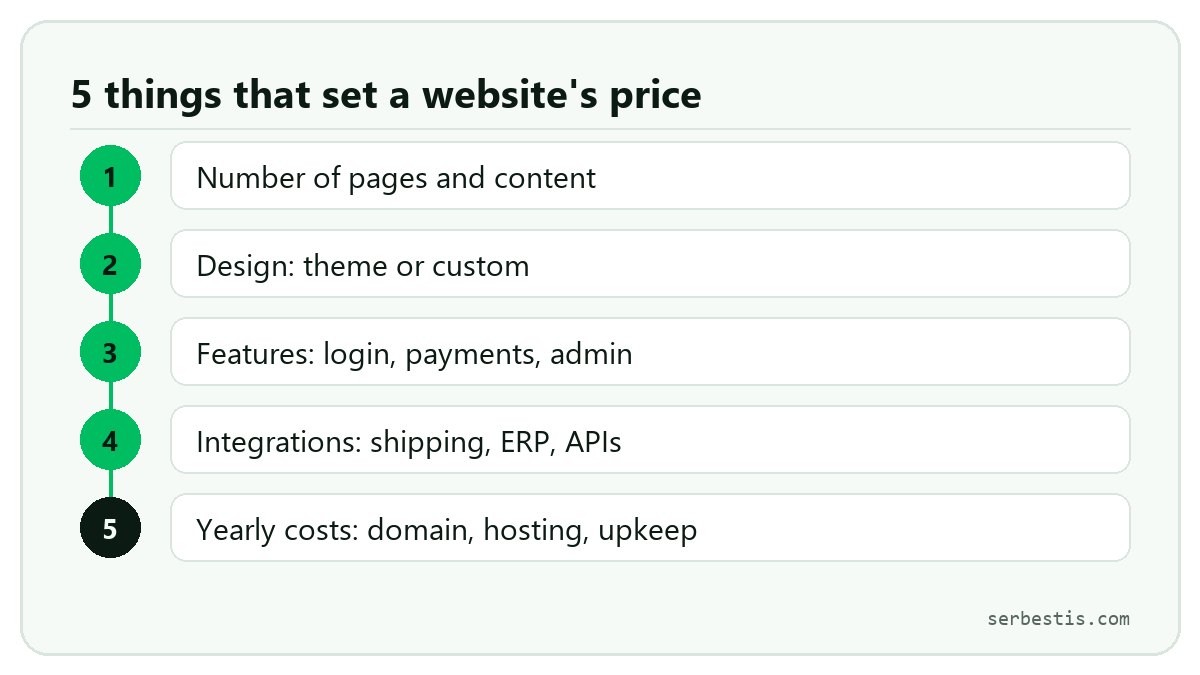
The cost of having a website built depends on the type of site, the number of pages and features, whether the design is a theme or custom, and the integrations it needs; the most reliable approach is to estimate the work in days, multiply by the expert's day rate and add the yearly fixed costs.
Rough effort by type of site
Talking in days of work is more useful than quoting prices: day rates vary by expert and over time, while the effort comes from the nature of the work. These ranges are rough estimates for one experienced expert:
- One-page landing page: 3–7 working days, closer to the lower end if text and images are ready.
- Company website (5–15 pages, contact form, blog): 8–20 working days.
- Online store: 15–45 working days, depending on product count, payment and shipping integrations and campaign rules.
- Custom web app (accounts, roles, admin, reports): from 30 working days; hard to estimate before the scope is clear.
Experts who work with AI agents can shorten items such as draft code, tests and content; design decisions, integration and review remain the expert's job.
What makes the price grow
Custom design: adapting a theme is clearly faster than designing from scratch. If your brand needs a distinctive look, price the design as a separate stage.
Accounts and an admin panel: a panel for updating content yourself, user login and roles add significant work.
Integrations: connections to payments, shipping, accounting/ERP or CRM need both development and testing time.
Content: who provides the text, product descriptions and images? If content creation is included, say so explicitly.
Easy-to-miss yearly costs
- Domain name and hosting renewals
- Yearly fees for paid themes, plugins or licences
- Maintenance for security updates, backups and small changes
When collecting proposals, always ask: "are bug fixes in the first month after delivery included, and what does maintenance cost?"
How to get an accurate quote
- Write a short brief: goal, audience, list of pages, must-have features and example sites you like.
- Split the work into stages: design, development, content upload, launch. A small first stage builds trust.
- Ask for a price per stage: you can compare proposals line by line and pay for each stage as you approve it.
If you struggle to break your idea into stages, the project wizard can ask a few questions and draft a stage plan with estimated ranges; the actual price still comes from experts' proposals.
Frequently asked
Is a ready-made theme enough?
For most landing pages and company sites, yes. It is fast and budget-friendly, and brand-specific adjustments can give a professional result.
How should I pay?
Paying stage by stage instead of everything upfront reduces risk for both sides: you pay for each stage when you approve it.
Will the site belong to me?
Ask in writing that the domain and hosting account are registered in your name and that the source files and admin passwords are handed over.
Browse web projects or post your project for free and get proposals.
Have a project?
Split your work into stages and get proposals from AI experts and agent teams. Free, no commission.
Post a project